Lektion 8
Genitiv

Translation: My family`s house
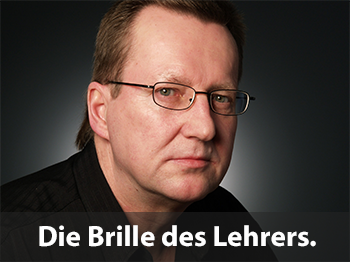
Translation: Teacher's Glasses
Additionl Info about Dative Case...
Some frequently used verbs whose objects always appear in the dative case are:
antworten (to answer)
Der Junge antwortet dem Polizisten mit “Ja.”The boy answers the policeman with “Yes.”
danken (to thank)
Das Kind dankt seiner Großmutter.The child thanks its grandmother.
glauben (to believe)
Die Frau glaubt dem Mann nicht.The woman does not believe the man.
helfen (to help)
Dem Passagier hilft die Flugbegleiterin.The woman flight attendant helps the male passenger.
gehören (to belong to)
Das Geld gehört dem Staate. The money belongs to the state.
Genitive Case
Genitive case signals a relationship of possession or “belonging to.” An example translation of this case into English might be from das Buch des Mannes to “the man’s book” or “the book of the man.” In English, possession is usually shown by either an ending (apostrophe + s) or with the preposition “of.” In German, the genitive case is primarily recognized from article forms and sometimes from noun endings.| Masculine | Feminine | Neuter | |
|---|---|---|---|
| definite article | das Buch des Mannes (the man’s book) |
das Buch der Frau (the woman’s book) |
das Buch des Mädchens (the girl’s book) |
| indefinite article | das Buch eines Mannes (a man’s book) |
das Buch einer Frau (a woman’s book) |
das Buch eines Mädchens (a girl’s book) |
| Plural | |||
| definite article | die Bücher der Frauen (the women’s books) |
||
| indefinite article | die Bücher keiner Frauen (no women’s books) |
Note:
- The noun in the genitive case follows the noun which it modifies.
- des and eines are useful forms to remember because they are completely unique to the singular genitive case and are thus helpful as starting points to figure out the grammatical structure of a sentence.
- Masculine and neuter nouns change forms in the genitive case (when singular). The noun endings –s or –es are added (-s for polysyllabic nouns, –es for monosyllabic).
- Proper nouns have an added –s ending to indicate genitive case (example: Deutschlands Kanzlerin), but if the proper noun already ends in s, then you will see no change in spelling. Apostrophes are not used in German.
Genitive Noun Chains
In formal or scientific German you will sometimes encounter chains of genitive-case noun phrases which are straightforward to read, but can be awkward to translate into smooth English. For example:
die Bücher der Professorinnen der Universität
(the books of the women professors of the university)
(the books of the women professors of the university)
Zum B.
| Was ist die Telefonnummer deiner schönen Kusine? | What is your beautiful cousin's phone number? |
Das Bild deiner Frau ist besonders gut. |
Your wife's picture is particularly good. |
Der Motor dieses Autos ist viel zu klein. |
This car's engine is much too small. |
Die größte Liebe aller deutschen Männer ist Fußball. |
The greatest love of all German men is soccer. |
Das Dach des Hauses war unbeschädigt. |
The roof of the house was undamaged. |
Genitive Case II
The German Genitive Case
Michael is showing us his house:Das ist das Haus meiner Familie. Hier ist das Schlafzimmer meiner Eltern und hier ist das Arbeitszimmer meiner Mutter. Das Zimmer meiner Schwester ist größer als das Zimmer meines Bruders.
(This is my family's house. Here is my parents' bedroom and here is my mother's study. My sister's room is bigger than my brother's room.)
In all of these sentences, Michael talked about possession and had to use the genitive case in the sentences.
The genitive in German will mostly be used to show possession. The question you will use to get the genitive is wessen? (whose?)
For example:
- Das ist das neue Auto des Mannes. (This is the man's new car.)
- Hier sind die Schlüssel der Kollegin. (Here are the colleague's keys.)
- Wo ist der Hut meines Vaters? (Where is my father's hat?)
Articles in the Genitive Case
Just like with all the other cases in German, the genitive will have a different article than der, die, das. Let's look at two charts to see what the definite and indefinite article will look like in the genitive case:Definite article der:
| Masculine | Feminine | Neutral | Plural | |
|---|---|---|---|---|
| nominative | der | die | das | die |
| genitive | des | der | des | der |
| Masculine | Feminine | Neutral | |
|---|---|---|---|
| nominative | ein | eine | ein |
| genitive | eines | einer | eines |
Nouns in the Genitive Case
Besides changing the article in front of the noun, we will also have to make some changes to the noun itself in the genitive case.When you take a look at a German dictionary, you may notice that next to the nouns there are two endings. The first one is the genitive ending and the second one is the plural ending.
- der Bruder, -s, -e (brother)
- feminine noun: die Katze, - , -en (A dash indicating no genitive ending because it is a female noun)
- masculine noun: der Freund, -es,-e
- neutral noun: das Kind, -es, -er
Caso Genetivo en español (adicional)...
FuncionesEn alemán los diferentes elementos de la frase (sujeto, objeto, etc.) pueden estar en diferentes posiciones. Para que entandamos de quien se trata o de quien se habla hay 4 casos diferentes.
El nominativo es el sujeto, es decir, el que realiza algo.
El genitivo sirve para designar quien es el dueño o a quien pertenece algo.
A menudo se utiliza la preposición „von“ para expresar un nombre en dativo.
La pregunta a la que responde el genitivo es „wessen?“(¿de quién?).
Casos en Aleman mas info...
Formación
Esta tabla refleja las reglas de declinación en genitivo de los artículos determinados e indeterminados en alemán. En alemán, el caso genitivo requiere también la declinación de los sustantivos masculinos y neutros.| Artículo determinado | Artículo indeterminado | |
|---|---|---|
| masculino | des Vaters | eines Vaters |
| femenino | der Mutter | einer Mutter |
| neutro | des Kindes | eines Kindes |
| plural | der Eltern | Eltern |
Übung:
| Die Farbe meiner Augen
ist blau. The color of my eyes is blue. |
|||
| Der Beruf des Mannes ist Arzt. The profession of the man is doctor. |
|||
| Der Bruder meiner Freundin heißt
Lars. My girlfriend's brother is named Lars. |
***
1.The color of my skin is brown.
2. The profession of the woman is doctor.
3. My boyfriend's sister is named Maria.
4. This is Maresa's family.
5. Where is the restaurant's manager?
6. Here is the car of a brother
7. Here is the house of my parents.
II. Mann, habe ich einen Hunger! ('Man, I am so hungry!') | |||||||||||||||||||||||||||||||||||||||||||||||||||||||||||||||||||||||||||||||||||||||||||||
Essential Restaurant VocabularyLet's start by looking at cognates related to restaurants. Cognates are simply terms that are very similar in two languages:
| |||||||||||||||||||||||||||||||||||||||||||||||||||||||||||||||||||||||||||||||||||||||||||||
 | |||||||||||||||||||||||||||||||||||||||||||||||||||||||||||||||||||||||||||||||||||||||||||||
| Leckere Pizza in einer Pizzeria. Yummy pizza in a Pizzeria | |||||||||||||||||||||||||||||||||||||||||||||||||||||||||||||||||||||||||||||||||||||||||||||
Essential Food And Drinks VocabularyLet's learn about basic food and drink vocabulary first before exploring a fancy new German specialty restaurant in Germany's capital, Berlin. Have a look at the following table to get the first taste of essential German food and drink terms. Make sure you read every word out loud to see how the specific term is pronounced in German!
|

No comments:
Post a Comment